
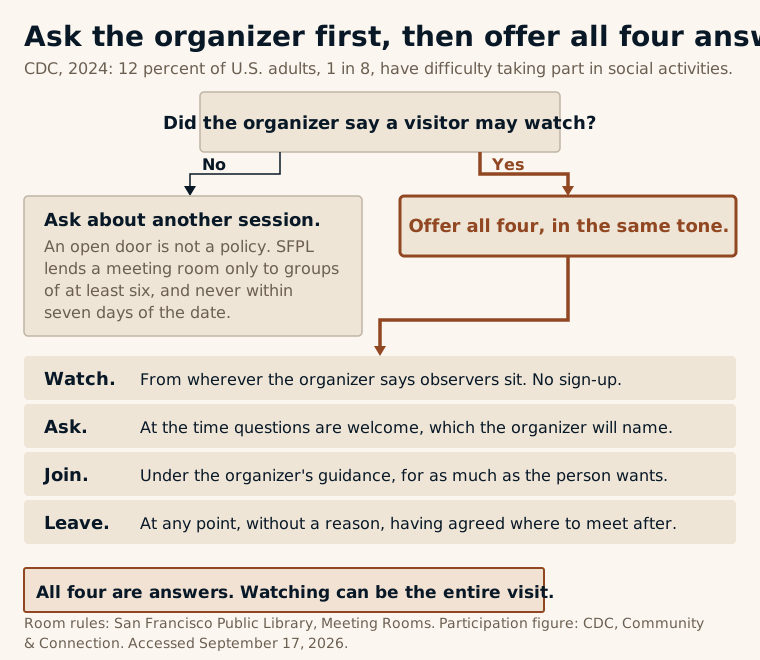
Ask the organizer whether watching is allowed, and only then offer the invitation. When it is allowed, give the newcomer four answers of equal standing: watch, ask a question, join, or leave. The need for that choice is ordinary — the CDC's 2024 figure is 12 percent of U.S. adults, 1 in 8, with difficulty taking part in social activities because of a physical, mental or emotional condition (CDC). The condition that changes the plan is the organizer’s rule: some sessions have a fixed roster, a registration step or a minimum group size, and there watching is simply not on offer.
Ask the organizer first
An open door is not a policy. Rules exist even where nothing is posted at the entrance, and the written ones are easy to underestimate: San Francisco Public Library lends its meeting rooms at no fee, but only for meetings that are free and open to the public, only to groups of at least six people, and never on a request submitted within seven days of the date (SFPL). A group meeting in that room cannot quietly add a spectator to a private session, because the session is not private in the first place.
So send one message before you send the invitation. "Can someone come and watch on Thursday without signing up?" is a question with a yes or a no in it.
Describe the format from its own source
Use the organizer’s words, or the words of the body that runs the program. Japan Post Insurance describes Radio Taiso as an exercise with a history of over 90 years, promoted in cooperation with NHK and the Japan Radio Taiso Federation, alongside Minna no Taiso, built on a universal-design idea so that a wide range of people can take part (Japan Post). That is a named program with named organizations behind it.
What it is not is a statement about the session down the road. A national program’s description tells you the shape of the exercise, not whether Thursday’s group takes visitors, uses chairs or has a step at the door. Keep the two apart when you explain it, and if the person wants the background first, read what the program is before pressing play.
Give the numbers, not a reassurance
If someone asks what the activity is "worth", quote the guideline rather than a promise. The CDC’s adult guideline is 150 minutes of moderate activity a week, or 75 minutes of vigorous activity, plus muscle-strengthening on at least 2 days, and the minutes do not have to be done in one block (CDC). A 40-minute session is a quarter of the weekly aerobic figure.
That is a fact about the guideline. Whether a particular exercise suits a particular person is a question for them and the people advising them, and a warm sentence from you is not an answer to it.
Offer four answers, not one
Say all four out loud, in the same tone, so none of them sounds like the disappointing option.
Watch. From wherever the organizer says observers sit. No sign-up, no participation.
Ask. At the time questions are welcome, which the organizer will name.
Join. Under the organizer’s guidance, for as much of the session as the person wants.
Leave. At any point, without a reason, having agreed beforehand where you will meet afterwards.
Watching is not a stage on the way to joining. It can be the entire visit, this week and every week, and the person does not owe the group a second appearance because they enjoyed the first.
An example that stays inside the permission
As an example, take a community demonstration where the organizer confirms two things: visitors may watch from the seating area, and questions are taken in the last ten minutes. The invitation then reads: "They let visitors watch from the seats, and there’s a question slot at the end. Would you like to come and watch with me? We can leave whenever you want, and there’s no sign-up."
Every clause in that message traces back to something the organizer said. Nothing in it promises that the person will enjoy the group, learn the movement or be able to perform it. Those were never yours to promise, and the same question list works before any session; if the person wants more detail first, ask the organizer the practical questions in advance.
Where to sit, and when to ask
Find out where observers stand or sit, whether photography and recording are allowed, and when the activity area is off limits. Someone who is uncertain should not have to become the center of the room to be included. A seat at the edge with a clear route out does more than any welcome speech.
Afterwards, keep the question neutral: "Was there anything you wanted to know more about?" CDC data for 2021 show that 82 percent of U.S. adults, or 4 in 5, felt they received the social and emotional support they needed (CDC), which is a reminder that most people already have somewhere to take the answer. Your part was the door, and the next step belongs to them — another visit, a different activity, or none.
Sources and further reading
- Community & ConnectionAccessed 2026-09-17
- Adult Activity: An OverviewAccessed 2026-09-17
- Promoting Healthy LifestylesAccessed 2026-09-17
- Meeting RoomsAccessed 2026-09-17