
Ask about one real session, in six questions, before you decide. Federal law already covers most of the venues: the ADA's definition of a place of public accommodation lists twelve categories, and the twelfth is a gymnasium, health spa, bowling alley, golf course, or other place of exercise or recreation. That tells you the questions are ordinary, not special pleading. What it does not tell you is whether this room, this hour and this pace fit you, which is why the questions go to the organizer rather than to the website.
Start from the rule that already covers the room
Category twelve covers the gym and the studio. Category eight covers a museum, library, gallery, or other place of public display or collection, which is where a lot of community sessions actually meet, and category nine covers a park or other place of recreation. A group meeting in a private home, or in space run by a religious organization, sits outside those categories, and the difference is worth knowing before you ask.
Name the two or three details that would decide your answer. You do not owe anyone a medical history to ask whether there are stairs.
Get the entrance in inches
"Accessible" is a claim; inches are a fact. Under the ADA Standards an accessible route is at least 36 inches (915 mm) wide, a doorway at least 32 inches (815 mm) clear, a ramp no steeper than 1:12 with a maximum rise of 30 inches (760 mm) per run, and handrails are required once a ramp run rises more than 6 inches (150 mm). A half-inch (13 mm) threshold is the most a doorway may have.
Ask which of those the entrance meets. An organizer who does not know can measure a doorway in a minute, and the act of measuring tells you something about how the group handles a question it has not been asked before. Ask about the route from the street as well as the door itself: a step-free entrance at the back of a building is only useful if the path to it is one you can take.
Ask what the session does, not what it is called
"All levels" describes a welcome, not an activity. CDC's test is what the body is doing: at moderate intensity you can talk but not sing; at vigorous intensity you cannot say more than a few words without pausing for breath. Ask which of those the middle of the session feels like, and ask what participants hold, push or lift, because that is what decides whether the hour is aerobic, strengthening, or both.
Ask how the pace and the pauses actually work
The Guidelines' safety advice for anyone starting out is to increase activity gradually, starting low and going slow, which only works if the session allows it. So: can someone sit out two movements and rejoin, or does the group move on as a block? Is there a chair in the room, or a chair you have to ask for?
An organizer who names a limitation plainly has given you useful information, even when the answer is no. A reply that says the room holds six chairs and the group uses them tells you more than a warm assurance that everyone is welcome at their own pace.
Send the six questions as one message
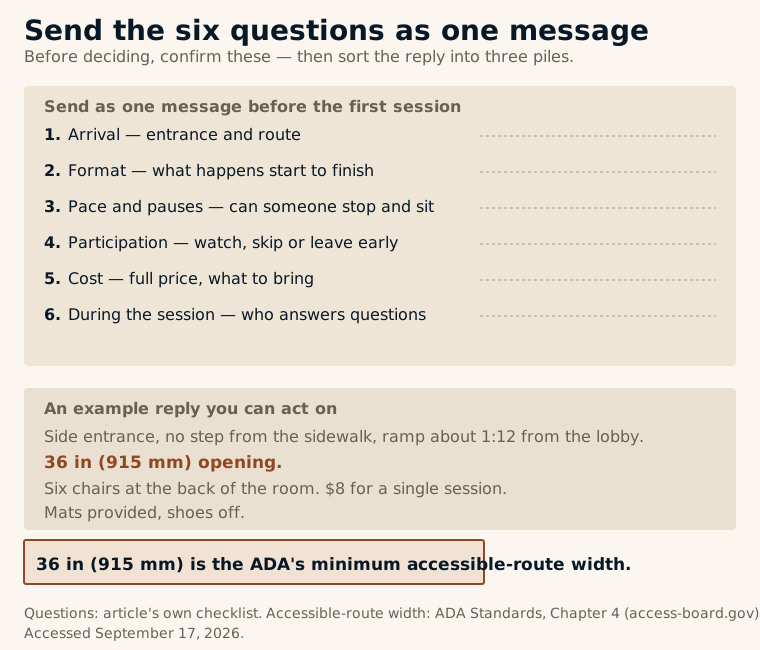
"Hello, I am interested in your ___ session on ___. Before deciding, could you confirm these?"
- Arrival. Which entrance, and are there steps, a lift, or another route to the room?
- Format. What happens from arrival to finish — continuous movement, practice in place, or stations?
- Pace and pauses. How are different paces handled, and can someone stop and sit without leaving?
- Participation. May a newcomer watch first, skip part, or leave early?
- Cost. What is the full cost for one occasion, and what must be brought or borrowed?
- During the session. Who answers questions, and what can they actually help with?
Add one question of your own instead of asking for a general assurance.
An example of a reply you can act on, with the figures the standard uses: side entrance, 36-inch opening, no step from the sidewalk, ramp about 1:12 from the lobby; six chairs at the back of the room; $8 for a single session; mats provided, shoes off. Every line there is either a measurement or a price.
Sort the reply into three piles
Confirmed, needs one more question, does not fit. "We have plenty of breaks" belongs in the middle pile until you know whether a seat comes with them. "Two steps at the front, step-free through the side door, ask at reception" belongs in the first pile, because it can be acted on. Keep the answer with the date and the venue, because a new room or a new leader resets it.
If the activity carries a named cultural practice, ask who teaches it and how they describe their training, the same care you would take when learning the name before borrowing the ritual. You can join, watch, ask again, or pass. Watching first is a real option worth offering to others as well, and the same questions about cost and access decide where two people can meet without buying anything.
Sources and further reading
- 28 CFR 36.104 DefinitionsAccessed 2026-09-17
- Chapter 4: Accessible RoutesAccessed 2026-09-17
- What Counts as Physical Activity for AdultsAccessed 2026-09-17
- Physical Activity Guidelines for Americans, 2nd editionAccessed 2026-09-17