
Plan the return before the distance, and ask for it in numbers. On federal land the Architectural Barriers Act standards require a trail to hold a clear tread width of at least 36 inches (915 mm), resting intervals at least 60 inches (1525 mm) long, and passing spaces at least every 1,000 feet (305 m). Those figures give you something specific to ask a city park or a library about, even where the standard itself does not apply. Slope is the condition that changes everything: a grade is allowed only for a stated distance, and the way back is where you meet it.
The numbers a federal trail has to hold
Four figures carry most of the decision. Clear tread width is 36 inches (915 mm) minimum, and it cannot be pinched by a gate or a bollard. Resting intervals are at least 60 inches (1525 mm) long. Cross slope is no steeper than 1:48, about 2 percent, on concrete, asphalt or boards, and up to 1:20, about 5 percent, on other surfaces where drainage needs it. Passing spaces come at least every 1,000 feet (305 m) on trails and every 200 feet (61 m) on an outdoor recreation access route, which is the shorter connector between a parking area and a picnic table or an overlook.
A photograph shows none of these. Treat an appealing image as a question to ask, not an answer.
Slope is a distance limit, not a feeling
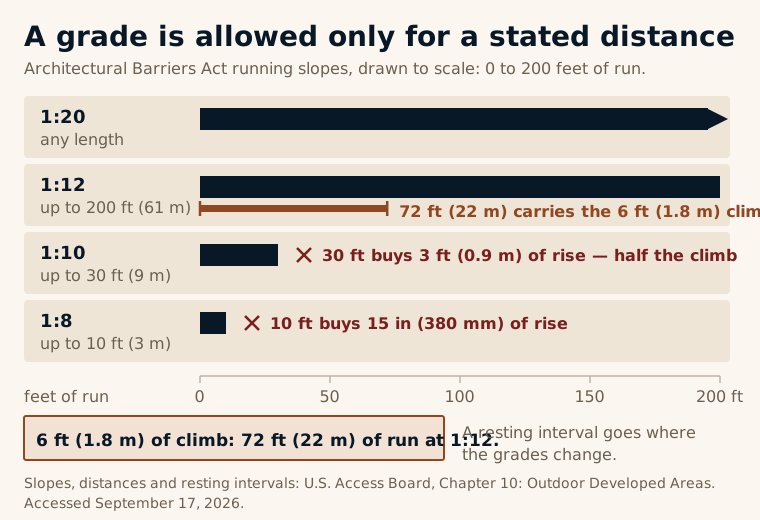
The running slope rules are a ladder. Up to 1:20, any length. Steeper than that and the clock starts: 1:12 for no more than 200 feet (61 m) at a stretch, 1:10 for no more than 30 feet (9 m), 1:8 for no more than 10 feet (3 m).
An example, using those limits. A path climbs 6 feet (1.8 m) from the water back to the parking lot. At 1:8 the standard allows only 10 feet of that grade, which buys 15 inches (380 mm) of rise, so it cannot carry the climb. At 1:10 the allowance is 30 feet, or 3 feet (0.9 m) of rise, which covers half. At 1:12 the allowance is 200 feet, and 6 feet of rise needs 72 feet (22 m) of run, comfortably inside the limit, with a resting interval where the grades change. The rule tells you what the way back has to look like before you walk down it.
Write the return-first note
Keep six lines, on paper or in a note, and fill them before you go.
- Start and finish. The actual entrance, not "the park". Most parks have several.
- Surface and transitions. What the operator states, and the point where the description stops.
- Crossings. The one you intend to use in each direction. They are rarely the same.
- Pause point. A place to stop, and whether seating is confirmed or assumed.
- Shorter return. A named turnaround that does not require finishing the route.
- Way home. A bus whose times you have read, or a pickup someone has agreed to.
An unverified alternative is a question, not a backup. The test for each line is whether someone else could act on it: "the north gate on Mill Street" can be found by a friend picking you up, and "the park entrance" cannot.
Decide before you write which single detail is the one you cannot do without. A step-free entrance, a bench within a quarter mile, a return before an appointment at four: a route can satisfy one of those and fail another, and knowing which one is yours turns a long list of unknowns into a single question to ask. For a short outdoor pause rather than a route, the same note works in three lines instead of six — a nearby seat and a way home is most of it.
What a park page can and cannot settle
The National Park Service runs 433 units across more than 85 million acres under at least 19 different designations, which is why there is no single answer to "is it accessible". The agency points visitors to each park's own page for accessible features, programs and services, and that page is the one to read. For a sidewalk, a library or a community center, the equivalent is the operator, not the agency.
Cost and the way back
Money belongs in the return plan too. The Access Pass is free for United States citizens and residents with a permanent disability, against $80 for the standard annual pass and $20 for the senior annual pass, and it covers entrance and standard day-use fees at national parks and other federal recreation sites.
Then read the note as though the route were new. If you cannot say where you start, where you can sit and how you get home after changing your mind, resolve that line or take the shorter known version. CDC's 150 minutes a week can be broken into smaller chunks, so a turnaround at the halfway point costs you nothing but the map. When the surface or the weather rules the route out entirely, an indoor option can hold the purpose, and the same questions work when you are asking an organizer about a group session.
Sources and further reading
- Chapter 10: Outdoor Developed AreasAccessed 2026-09-17
- National Park System (U.S. National Park Service)Accessed 2026-09-17
- Accessibility (U.S. National Park Service)Accessed 2026-09-17
- Entrance Passes (U.S. National Park Service)Accessed 2026-09-17
- Adult Activity: An OverviewAccessed 2026-09-17