
Meet at a public library or a public park, and read the operator’s own page before you name a time. The Main Library of the San Francisco Public Library, at 100 Larkin Street, is open Tuesday through Thursday from 9 to 8 and on Sunday from noon to 6, and nobody pays to walk in (San Francisco Public Library). The condition that changes the plan is group size: the same library’s meeting rooms carry no fee but require at least six people and a meeting that is free and open to the public (SFPL’s meeting-room page), so two people who want to talk belong in a study room, a reading area or a park instead.
Free is a rule set, not an absence
A place without a cash register still has terms, and they are written down. SFPL states that meeting-room requests submitted within seven days of the meeting date are not accepted, that requests for the Koret Auditorium or the Latino/Hispanic Community Room are not accepted within 30 days, and that rooms must be vacated 30 minutes before closing (SFPL’s meeting-room page). Study rooms in the same building are first-come, first-served for smaller groups, with no application at all.
Read those rules as a planner rather than as fine print. A room you cannot book on Thursday for Saturday is not available to you this week. A room that empties half an hour before closing shortens the visit you are picturing. A requirement that the meeting be open to the public rules out the private conversation you had in mind.
Two people almost never need the room. That is the quiet finding in the rules: the free thing you actually want, a table and an hour, is the thing with the fewest conditions attached.
A park has a timetable too
Golden Gate National Recreation Area is reachable 24 hours a day in most areas, but its parking lots are open only between sunrise and sunset, and named sites including Lands End, China Beach, Sutro Heights Park and Muir Beach run from 6 a.m. until one hour after sunset (National Park Service). One hour after sunset is a moving number. In late December in San Francisco that falls before 6 p.m.; in late June it falls after 9.
So the word "park" tells you nothing about whether your 7 p.m. plan works in November. The site page does. Check the specific place you intend to sit in, not the park that contains it, and check it in the month you are meeting.
Check the route before you check the view
Access is a set of measurements, and the federal ones are published. Under the ADA, the access aisle beside an accessible car space must be at least 60 inches (1.5 m) wide, a van space at least 132 inches (3.4 m) wide, at least one space in every 25 must be accessible, at least one of every six accessible spaces must be van accessible, and the sign must sit at least 60 inches (1.5 m) above the ground (ADA.gov). Those numbers give you something exact to ask an operator about instead of "is it accessible?".
The need is not unusual. CDC data for 2024 show that 12 percent of U.S. adults, or 1 in 8, had difficulty participating in social activities because of a physical, mental or emotional condition (CDC). Ask each person what they need, and treat "I need a chair with a back" as a complete answer that needs no explanation attached to it.
Compare three places on the terms that decide it
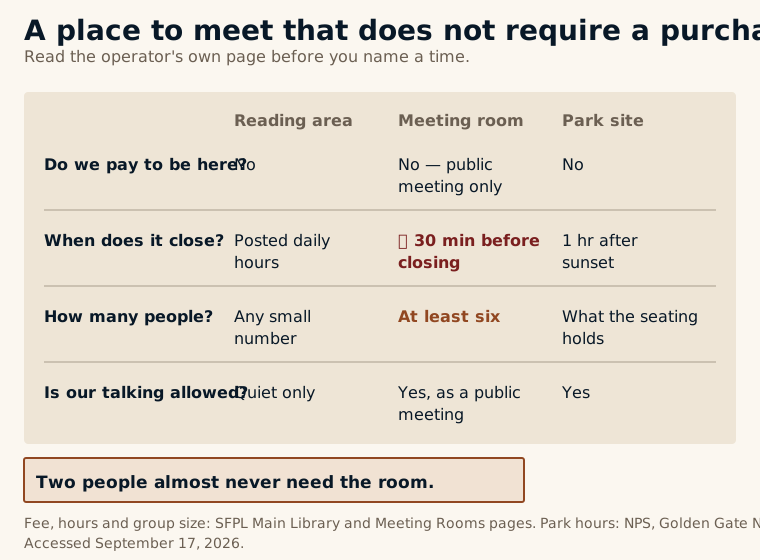
Write "unknown" in any cell you have not read on the operator’s own page. An empty cell is not a yes, and a photograph from three years ago is not an opening hour.
Send the entrance, not the building
As an example, take a Tuesday visit for two at 100 Larkin Street. The building opens at 9 and closes at 8, so 6 p.m. leaves two hours; no booking applies, because two people use a study room on a first-come basis; and the message names the Larkin Street entrance, the floor and one fallback. That is a plan somebody can follow without calling you from the sidewalk.
Keep the same habit outdoors, where the return trip decides more than the destination and a rest outside works best close to home. Once the terms are settled, what is left is simply an invitation to one ordinary thing with a place and an hour attached to it.
Sources and further reading
- Main LibraryAccessed 2026-09-17
- Meeting RoomsAccessed 2026-09-17
- Operating Hours & Seasons - Golden Gate National Recreation AreaAccessed 2026-09-17
- Accessible Parking SpacesAccessed 2026-09-17
- Community & ConnectionAccessed 2026-09-17