
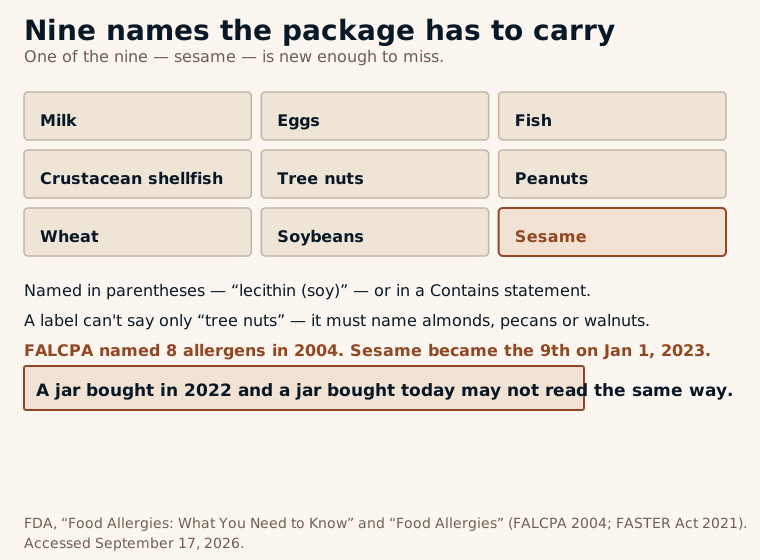
Ask before you shop, and ask against the label rather than against your memory. The FDA names nine major food allergens — milk, eggs, fish, Crustacean shellfish, tree nuts, peanuts, wheat, soybeans and sesame — and requires each one to be identified either in parentheses after the ingredient, as in "lecithin (soy)", or in a "Contains" statement beside the ingredient list, with sesame added to that list of 9 from 1 January 2023 (FDA). The condition that changes the question is packaging: a sealed jar answers it in print, while a dish from a counter or a potluck carries no such statement, so there you name every ingredient out loud.
Nine names the package has to carry
Sesame is the newest of the nine. The FASTER Act was signed on 23 April 2021 and made sesame the ninth major food allergen, with labeling required from 1 January 2023; the other eight come from the Food Allergen Labeling and Consumer Protection Act of 2004 (FDA). A jar bought in 2022 and a jar bought today may not read the same way.
The declaration is also more specific than the category. A label cannot say only "tree nuts", "fish" or "Crustacean shellfish"; it has to name almonds, pecans or walnuts, bass, flounder or cod, crab, lobster or shrimp (FDA). That is the level of detail your guest needs from you as well, and it is a fair standard to hold your own description to.
Ask for the requirement, not the reason
A useful opening is short: "I’m planning this dish. Here are the ingredients. Is there anything you need me to know about the food or the arrangements?" Send the ingredient list if you have one, and keep the exchange private.
Then write down what you hear, in the guest’s own words, and keep it to the people who need it. If another cook has to know, ask your guest how they would like it passed on. A requirement travels better as a sentence than as a summary.
Nobody owes you an explanation. A requirement works on its own, and a person describes their own practice more accurately than any inference from a name, an appearance, a religion or a previous meal. UNESCO’s 2020 inscription of couscous knowledge, submitted jointly by Algeria, Mauritania, Morocco and Tunisia, describes preparation transmitted informally through observation and imitation, with variation built into the transmission itself (UNESCO). One listing covers four countries and countless households, which is precisely why no listing can tell you what belongs on your guest’s plate.
Ask about participation in the same message. Some people want to help, some want to arrive when the food is ready, and both answers are complete; when the kitchen work is part of the invitation, settle the roles before anyone starts.
What a "Contains" line does not cover
The statement covers what is deliberately in the package. It is not a report on the kitchen you are about to cook in, on shared knives and boards, or on a pan that held something else an hour ago. Say plainly which of those you control and which you do not, and let your guest decide from there.
A voluntary advisory line such as "may contain" is a manufacturer’s own wording rather than the required declaration, so it answers a different question than the "Contains" statement does. Read both and quote both when you report a label to somebody else. Exact wording beats a paragraph of reassurance.
The ordinary safety numbers still apply to everyone at the table. Wash hands for at least 20 seconds, hold the refrigerator at 40°F (4°C) or below, cook poultry to 165°F (74°C) and reheat leftovers to 165°F (74°C) (CDC). Those are cooking rules, and they sit alongside the arrangement you agree with a guest whose requirement is medical rather than replacing it.
Confirm the change before the pan is hot
As an example, take a sauce swap. A guest reads the ingredient list on Tuesday and agrees to the dish. On Thursday the usual jar is out of stock, and the replacement’s label reads "Contains: Wheat, Soy, Sesame" where the first one named no sesame at all. The useful step is one message carrying the new label’s exact wording, sent before anything is opened.
If no answer arrives in time, change the arrangement rather than the risk. Each person brings their own meal, or you meet after eating, or you cook the version already confirmed. The same habit pays off whenever a product changes mid-recipe, since a label only answers in the portion you actually use.
Read the final agreement once before you begin: what dish, which labels, who is doing what, and what is still open. A guest who can picture the meal has already been welcomed.
Sources and further reading
- Food Allergies: What You Need to KnowAccessed 2026-09-17
- Food AllergiesAccessed 2026-09-17
- Preventing Food PoisoningAccessed 2026-09-17
- Knowledge, know-how and practices pertaining to the production and consumption of couscousAccessed 2026-09-17