
Split the evening into six named jobs before anyone touches a knife: choose, explain, prepare, observe, serve, finish. Assign each one out loud, and give the thermometer to a single person, because the numbers that decide whether dinner is safe are exact — poultry to 165°F (74°C), ground meats to 160°F (71°C), whole cuts of beef, pork, veal and lamb to 145°F (63°C) with a three-minute rest, leftovers to 165°F (74°C) (CDC). The condition that changes the arrangement is appetite for the work: when only one person wants their hands on the food, watching is a finished role rather than a waiting room.
Name six jobs, not one activity
"Cooking together" hides most of the labor. Choosing the dish, checking that the ingredients are in the house, explaining an unfamiliar step, plating, and washing up afterwards are all part of the evening, and they are the parts that quietly land on one person when nobody names them.
Choose covers the dish, the shopping and the ingredient check — settle who decides, and by when. Prepare covers knife work, heat and timing — settle which tasks each person knows and wants. Observe covers watching, asking and staying out of the way — settle where to stand, when questions are welcome. Serve covers the table, plates, drinks and timing the food — settle who leaves the stove to do it.
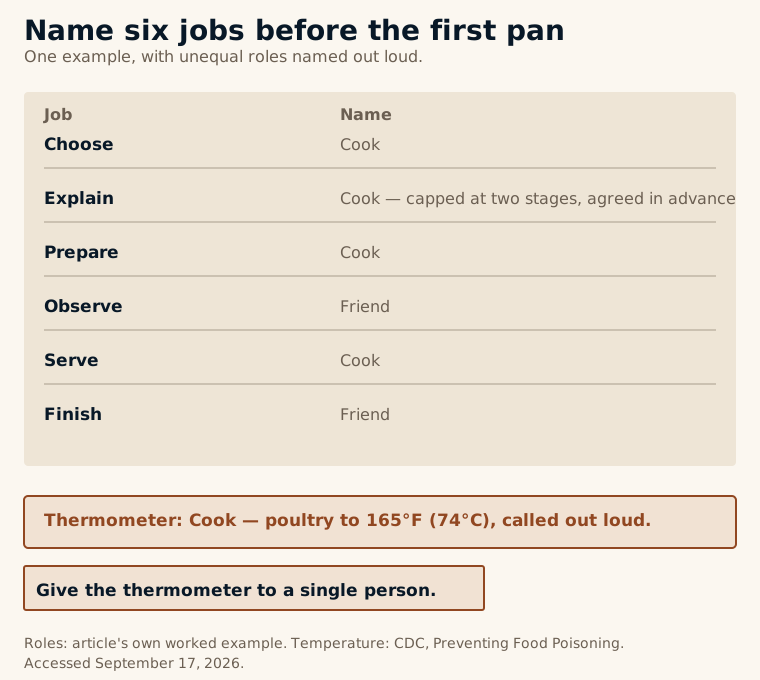
One person can hold several jobs. A job nobody needs can be struck out. What matters is that the list is spoken before the first pan goes on, not reconstructed afterwards from who is still standing at the sink.
Observation is a role with a source behind it
Watching is how a great deal of cooking knowledge actually moves. UNESCO inscribed knowledge and practices around couscous on its Representative List in 2020, in a file submitted by Algeria, Mauritania, Morocco and Tunisia, and describes the preparation as transmitted informally through observation and imitation, with more formal transmission developing outside the family circle only in recent decades (UNESCO). Observation is the older method, and the listing says so.
That is an argument for offering the observer’s chair, not for assigning it. Nobody who knows a family dish is obliged to teach it, and no one should be handed a task because of their age or their gender. Ask the question directly: "Would you like to cook with me, keep me company while I cook, or arrive when it’s ready?"
Access shapes the answer as much as preference does. In the CDC's 2024 data, 1 in 8 U.S. adults (12 percent) reported difficulty taking part in social activities because of a physical, mental or emotional condition (CDC). A kitchen with one narrow aisle and nowhere to sit has already made the choice for somebody. A chair at the end of the counter reopens it.
Put the thermometer in one person’s hands
Shared cooking creates a specific failure: two people each assume the other checked. Name the person who owns the temperatures, and let them own the clock as well. Bacteria multiply fastest between 40°F (4°C) and 140°F (60°C), hands are washed for at least 20 seconds, and the refrigerator holds at 40°F (4°C) or below (CDC).
Those rules are short enough to say aloud while you work, which is also a decent way to explain a step to someone who is watching. If a guest at the table has a requirement, settle it well before this point, because the ingredient conversation belongs to the shopping, not the stove.
An example with unequal roles
As an example, take two people and one familiar chicken dish. The cook takes choose, prepare and serve; the friend takes observe and finish; explain is capped at two stages, agreed in advance, so the cook is not narrating for 40 minutes. The cook keeps the thermometer and calls 165°F (74°C) out loud. The friend clears and stores, and the leftovers go into the refrigerator inside two hours.
The shape is uneven and completely explicit. That is the difference between an arrangement and the more common version, where one person selects, shops, teaches, cooks and cleans while the evening is described as shared.
If the cook does not want to teach, that belongs in the first sentence. "I’d like the company, but I don’t have room to explain each step tonight" is a clear offer, and the other person can decide whether it is the evening they want.
Agree who finishes before anyone starts
The last row of the list is the one that gets skipped. Say who washes, who stores and at what hour, while everyone still has energy to agree to it. A dish left for the person who cooked is a bill that arrives after the guests leave.
Roles can change next time, and they do not have to. Rotation is an option rather than a rule that overrides what somebody can actually do. The same logic governs a first visit to any group activity, where watching before joining is a complete way to take part, and it starts with the simplest version of all: a shared meal that begins with two people.
Sources and further reading
- Preventing Food PoisoningAccessed 2026-09-17
- Knowledge, know-how and practices pertaining to the production and consumption of couscousAccessed 2026-09-17
- Community & ConnectionAccessed 2026-09-17