
Compare two sauces at the spoonful, because their printed servings are not the same size. FDA's reference amounts put barbecue sauce at 2 tablespoons and put catsup, soy sauce, teriyaki sauce and marinades in a separate category at 1 tablespoon (FDA reference amounts). At one tablespoon, USDA records soy sauce at 878 milligrams of sodium — 38 percent of the 2,300-milligram Daily Value — and catsup at 154. The condition that changes the answer: when you cannot weigh what you pour, compare at the printed serving and write down that you did.
The printed serving is a category, not your portion
FDA sets serving sizes from the amount people typically consume, not the amount anyone should eat, and says so plainly on its serving-size page. The number is assigned by product category. Barbecue sauce shares a category with hollandaise, tartar sauce and dips at 2 tablespoons; the major condiments — catsup, steak sauce, soy sauce, vinegar, teriyaki, all marinades — sit at 1 tablespoon.
So a bottle showing the lower sodium number may simply be printing a smaller spoon. Nothing is being hidden. The label is doing what the rule tells it to do, and the comparison is yours to make.
Four sauces at one tablespoon
USDA gram weights and nutrient figures, converted to a single tablespoon of each.
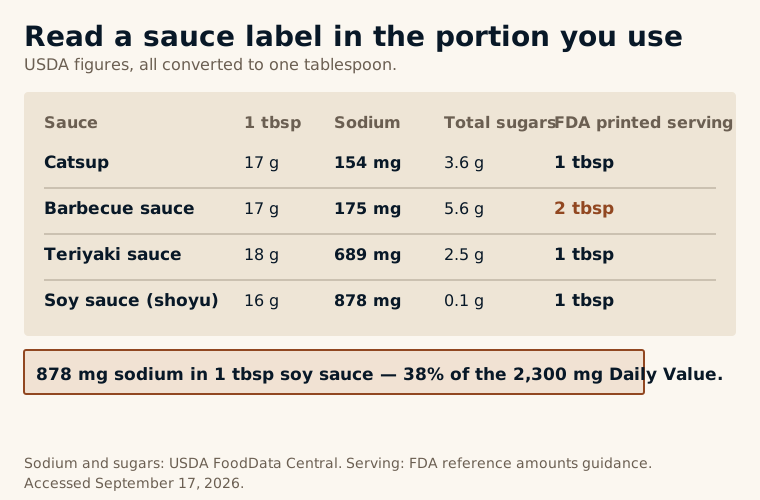
On equal spoonfuls the two tomato sauces land within 21 milligrams of sodium of each other and differ on sugar; the two soy-based sauces carry four to six times the sodium of either. That is the comparison the front of the bottle does not make.
The calculation, and where the units go
The reusable line is short:
Amount used ÷ printed serving × nutrient per serving.
Grams are the safest unit for both halves, because a tablespoon of one sauce does not weigh what a tablespoon of another does — USDA puts catsup at 17 grams and teriyaki at 18. Keep milligrams and grams separate in the result: sodium is in milligrams, sugars in grams, and the two never add.
A worked dinner, in two spoonfuls
An example, measured in tablespoons. A sheet-pan dinner gets 2 tablespoons of barbecue sauce brushed on, and the stir-fried greens beside it get 1 tablespoon of soy sauce.
Barbecue sauce at 34 grams: 350 milligrams of sodium, 15 percent of the Daily Value, and 11.3 grams of total sugars. Soy sauce at 16 grams: 878 milligrams of sodium. Together, 1,229 milligrams — 53 percent of the day's 2,300 before the rest of dinner is counted. Swapping in low-sodium shoyu, which USDA weighs at 14.2 grams a tablespoon and lists at 3,600 milligrams per 100 grams, brings that spoonful to 511 milligrams and the total to 861.
Total sugars and added sugars are different rows
The USDA figures above are total sugars. The label prints a separate Added Sugars line, which covers sugars put in during processing, syrups, honey and concentrated juices, and carries a Daily Value of 50 grams (FDA). Total sugars have no Daily Value, because no recommendation exists for them.
For a barbecue sauce, most of the sugar is added and the two rows sit close together. For a tomato sauce with no sweetener, they do not. Read the row you meant to read, and the FDA's shorthand still applies to either: 5 percent of a Daily Value or less per serving is low, 20 percent or more is high (FDA).
When the sauce goes into a shared pot
Calculate the sauce's contribution to the whole dish first, then divide only if the dish is actually divided evenly. An uneven ladle does not support a per-person figure, and saying so takes one line in your note.
Then make the real decision, which is rarely the arithmetic. Taste, the recipe, what the household will eat and what is already open all outrank a 21-milligram difference. Where the gap is large — the 367 milligrams between regular and low-sodium shoyu in one spoonful — it is worth acting on, in the same way the choice between a regular and a no-salt-added can is the one thing worth acting on in fresh, frozen or canned for tonight, and the same reason a jar of kimchi is read for its sodium row in fermented food and probiotic claims are different questions.
Sources and further reading
- Guidance for Industry: Reference Amounts Customarily Consumed (List of Products for Each Product Category)Accessed 2026-09-17
- Serving Size on the Nutrition Facts LabelAccessed 2026-09-17
- Catsup (FDC 168556)Accessed 2026-09-17
- Sauce, barbecue (FDC 174523)Accessed 2026-09-17
- Sauce, teriyaki, ready-to-serve (FDC 171167)Accessed 2026-09-17
- Soy sauce made from soy and wheat (shoyu) (FDC 174277)Accessed 2026-09-17
- Soy sauce made from soy and wheat (shoyu), low sodium (FDC 172473)Accessed 2026-09-17
- Added Sugars on the Nutrition Facts LabelAccessed 2026-09-17
- How to Understand and Use the Nutrition Facts LabelAccessed 2026-09-17