
Replace the word with two questions that have answers: which named people and place the food comes from, and which of the FDA's defined claims it actually earns. A cup of cooked quinoa weighs 185 grams and carries 5.2 grams of fiber, calculated from USDA's entry for cooked quinoa — inside the 10-to-19-percent band of the Daily Value that FDA labeling rules call a good source, below the 20 percent that earns the word high. The condition that changes everything: once a seller names a disease or a body function, the sentence has left food labeling and become a claim that needs its own evidence.
What the FDA's words mean, and what "superfood" does not
FDA sorts label statements into three kinds: health claims, which link a substance to reduced risk of a disease; nutrient content claims, which characterize how much of a nutrient is present; and structure/function claims, which describe an effect on the body's normal workings (FDA, label claims). Only the middle category carries arithmetic you can check. FDA's labeling guidance sets high at 20 percent or more of the Daily Value per reference amount and good source at 10 to 19 percent, under 21 CFR 101.54 (FDA, claims guidance).
"Superfood" is in none of the three. It sits on the front of the package, where no threshold applies, which is exactly why it is worth translating before you buy.
Five lines that make an origin note usable
Fill these for one ingredient, one article or one package. Each line has a right answer or an honest blank.
- Name as the source writes it. Copy it exactly, including the variety or region.
- People and place. The community, the cook, the growing region actually identified. Not "ancient peoples".
- Source and year. Institution, title, link, date of the account.
- What it covers. Cultivation, a household meal, an inscription, a research visit, a shipping record.
- Still unknown. What the source does not say about your package, your variety, or current practice.
Line five is the one that keeps the note honest, and it is usually the longest.
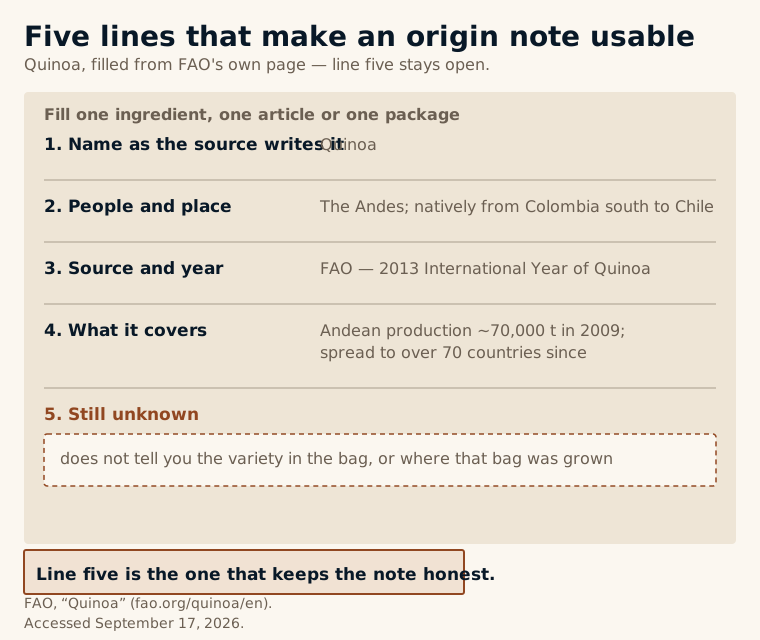
Quinoa, filled in
An example, using public sources. FAO records that the United Nations General Assembly declared 2013 the International Year of Quinoa, that quinoa originates in the Andes and grows natively from Colombia south to Chile, that Andean production was around 70,000 tonnes in 2009, and that cultivation has since spread to more than 70 countries (FAO). Lines one to four are answerable from that page. Line five stays open: it does not tell you the variety in the bag on your shelf or where that bag was grown.
Then the arithmetic. One cup, 185 grams: 5.2 grams of fiber against the 28-gram Daily Value printed on the Nutrition Facts label, 8.1 grams of protein, 13 milligrams of sodium. Good source of fiber, low in sodium, and nothing that requires a new word. A cup of boiled lentils, at 15.6 grams of fiber, has three times as much, which is one reason beans and lentils belong in more than one kind of meal.
Where the health promise goes
Keep the cultural account and the health claim in separate notes, because neither supports the other. UNESCO's 2010 inscription of traditional Mexican cuisine, the Michoacán paradigm, describes a food system built on corn, beans and chili and maintained by collectives of women cooks in Michoacán and across Mexico (UNESCO). That is a record of practice, not a finding about anyone's body.
When a seller's sentence does name an outcome, follow the evidence link before the verdict, and write down what is missing rather than filling it in: product not identified, population unclear, outcome not measured. NCCIH's Know the Science material walks through reading a study and a health news story for exactly those gaps (NCCIH). The same three-part split does the work when a jar says "probiotic", which is where fermented food and probiotic claims are different questions goes next.
A finished origin note can end in curiosity: this source, this place, this year, and this still unanswered. It does not need an extraordinary promise, and the cooking works the same either way — the same discipline that keeps a changed recipe honest when you keep the family dish and name your changes.
Sources and further reading
- Quinoa, cooked (FDC 168917)Accessed 2026-09-17
- Label Claims for Conventional Foods and Dietary SupplementsAccessed 2026-09-17
- Dietary Supplement Labeling Guide: Chapter VI. ClaimsAccessed 2026-09-17
- QuinoaAccessed 2026-09-17
- How to Understand and Use the Nutrition Facts LabelAccessed 2026-09-17
- Traditional Mexican cuisine — ancestral, ongoing community culture, the Michoacán paradigmAccessed 2026-09-17
- Know the ScienceAccessed 2026-09-17