
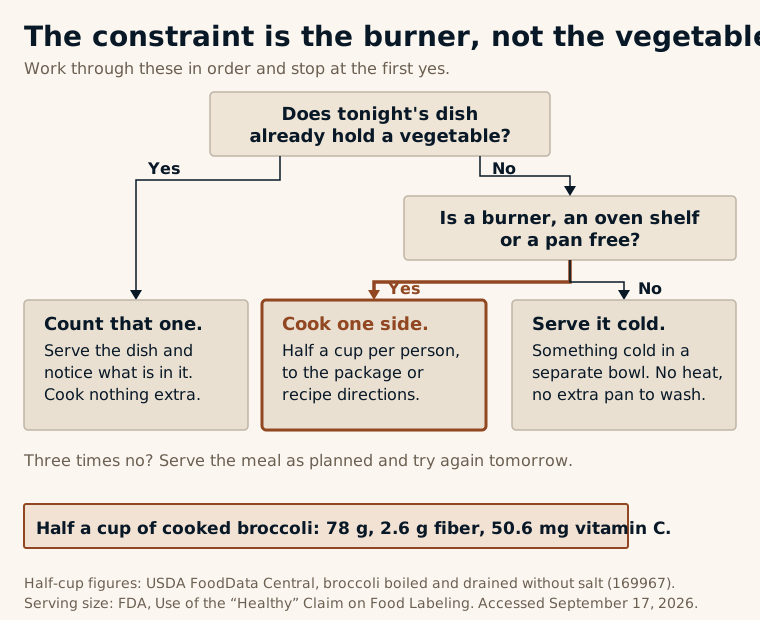
Add one half-cup side to the meal you already planned. Half a cup of cooked broccoli weighs 78 grams and carries 2.6 grams of fiber and 50.6 milligrams of vitamin C, calculated from USDA's entry for broccoli, boiled and drained without salt. Half a cup is also the amount the FDA counts as one vegetable serving in its updated "healthy" claim, announced on 19 December 2024. The one condition that changes the answer: when the main dish already holds a vegetable, count that one and cook nothing extra.
Half a cup is the unit the rules already use
Under that FDA rule, a packaged food earns the word "healthy" partly by containing at least a half-cup equivalent of vegetables and by staying at or below 230 milligrams of sodium, which the agency puts at 10 percent of the Daily Value. Half a cup is a small amount of food. It fits in a cereal bowl beside the plate.
CDC's analysis of 2019 survey data found that 10.0 percent of US adults met the vegetable recommendation, measured against 2 to 3 cup-equivalents a day; the state figures ran from 5.6 percent in Kentucky to 16.0 percent in Vermont (CDC, MMWR, 2022). One half-cup side covers a sixth to a quarter of that daily range. Two cover a third to a half. Neither asks you to rebuild dinner.
Pick the role before you pick the vegetable
Work through these in order and stop at the first yes.
- Does the dish already contain a vegetable? Then the side is done. Serve the dish and notice what is in it.
- Is there a burner, an oven shelf or a pan free? Then a cooked side fits. Half a cup per person is the target; cook to the package or recipe directions.
- Is nothing free? Then serve something cold in a separate bowl. No heat, no second recipe, no extra pan to wash.
- Is the answer no three times? Serve the meal as planned and try again tomorrow.
The order matters because the constraint is almost never the vegetable. It is the burner, the fifteen minutes, or the second bowl nobody wants to wash.
Three roles cover nearly every weeknight. A vegetable can arrive as an accompaniment served cold or at room temperature, as a cooked side that needs heat and a pan, or as an ingredient already inside the dish. The first costs a bowl, the second costs equipment and attention, the third costs nothing at all. Choosing the role first keeps the question about tonight's kitchen rather than about the vegetable aisle, and it stops a familiar meal from being renamed a healthy version of itself.
One burner, one bowl: a worked example
Two adults, a 6 pm noodle dish, one usable burner already holding the sauce. Frozen peas go in a bowl instead of a pan.
Half a cup of frozen peas, boiled and drained without salt, weighs 80 grams and carries 3.6 grams of fiber, 58 milligrams of sodium and 7.9 milligrams of vitamin C, from USDA's frozen-pea entry. USDA records a 10-ounce package as yielding 253 grams cooked, so one bag covers three of these sides. Sodium at 58 milligrams is well under the FDA's 230-milligram line for a serving, so the side is not what sets the meal's salt; the sauce is, which is a separate question about reading a sauce label in the portion you use.
When the side does not come back
If the bowl goes back to the kitchen full, name the reason before you change the vegetable. Texture, temperature, timing and seasoning fail in different ways, and only one of them is fixed by buying something else. A cooked side that nobody touched at 6 pm is often a side that arrived at 6:20.
Serving the side separately rather than stirring it in is the cheapest fix available, because it lets each person decide how much belongs on their plate and keeps the main dish tasting the way the household expects. It also makes leftovers easier: a bowl of plain cooked vegetables reheats on its own, while a vegetable stirred into a sauce is committed to that sauce.
Two swaps are worth trying before you give up on a vegetable: a different form, and a different bowl. The first is covered in the comparison of fresh, frozen or canned for tonight. The second is free. And when the household wants something with more weight to it than a side, cooked pulses do a different job, which is where beans and lentils belong in more than one kind of meal picks up.
Sources and further reading
- Broccoli, cooked, boiled, drained, without salt (FDC 169967)Accessed 2026-09-17
- Use of the “Healthy” Claim on Food LabelingAccessed 2026-09-17
- Adults Meeting Fruit and Vegetable Intake Recommendations — United States, 2019Accessed 2026-09-17
- Peas, green, frozen, cooked, boiled, drained, without salt (FDC 170017)Accessed 2026-09-17