
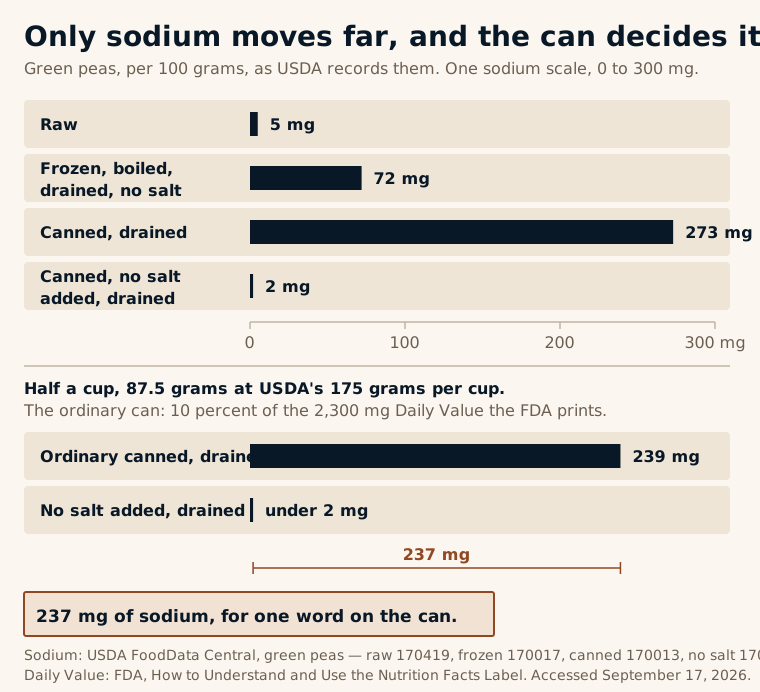
Buy the form you will actually cook this week. Across USDA's four entries for green peas, fiber, protein and calories sit within a gram or two of each other; the figure that moves far is sodium, from 2 milligrams per 100 grams in canned peas with no salt added to 273 milligrams per 100 grams in ordinary canned peas, drained (USDA FoodData Central). The condition that changes the answer is the recipe: when a dish depends on a particular texture, the form decides and the sodium is handled with a colander.
Four forms of one vegetable, measured
Green peas, per 100 grams, as USDA records them.
Scroll sideways to see the full table →
| Form | Sodium | Vitamin C | Fiber |
|---|---|---|---|
| Raw | 5 mg | 40.0 mg | 5.7 g |
| Frozen, boiled, drained, no salt | 72 mg | 9.9 mg | 4.5 g |
| Canned, drained | 273 mg | 4.2 mg | 4.9 g |
| Canned, no salt added, drained | 2 mg | 9.6 mg | 4.1 g |
Fiber runs from 4.1 to 5.7 grams across all four. That is the whole spread. No form in this table is disqualified by its fiber row, and nothing on the front of any of these packages would have told you so.
Sodium is the only large gap, and it is fixable
Half a cup of ordinary canned peas, 87.5 grams at USDA's 175 grams per cup, carries 239 milligrams of sodium — 10 percent of the 2,300-milligram Daily Value the FDA prints on the label. The same half cup of the no-salt-added product carries under 2 milligrams. That 237-milligram difference costs nothing but the word on the can.
The FDA's own shorthand is useful here: 5 percent of a Daily Value or less per serving is low, 20 percent or more is high. Ordinary canned peas sit between the two, which is why the can is a fine choice and the packing liquid is the part to act on. One limitation is worth stating once: USDA's figures describe the food as analyzed, and a particular brand's label is the figure for that brand's product. Rinsing is the other lever, and it is the same lever that moves canned beans, covered in beans and lentils belong in more than one kind of meal.
Fresh keeps an edge on vitamin C, and it is smaller than the bag suggests
Broccoli shows the gap plainly, because both versions are eaten cooked. Boiled and drained without salt, fresh broccoli holds 64.9 milligrams of vitamin C per 100 grams; frozen broccoli cooked the same way holds 40.1 milligrams. Fresh wins that row.
Then look at portions. A cup of cooked frozen broccoli weighs 184 grams and delivers 73.8 milligrams of vitamin C — more than the half cup of fresh, at 78 grams and 50.6 milligrams, because the amount you serve moves the number further than the form does. The frozen version also carries 20 milligrams of sodium to the fresh version's 32.
One meal, one decision
An example, with the package sizes as sold. A weeknight dish for two needs peas stirred in at the end. The freezer already holds a 10-ounce package, which USDA records as yielding 253 grams cooked — enough for three half-cup sides at 80 grams each, with a spoonful left. Sodium from the peas: 58 milligrams per half cup. Nothing else about the meal changes.
Now the same dish with no freezer space. A can of ordinary peas, drained, puts 239 milligrams of sodium per half cup on the plate instead of 58. The fix is the no-salt-added can, not a trip for fresh pods, and the arithmetic is the same one used when reading a sauce label in the portion you use: amount used, divided by the printed serving, times the nutrient in that serving.
Buying for a week you cannot predict
Frozen holds its schedule. It does not spoil on Thursday because Tuesday ran late, and USDA's frozen broccoli entry sits close to the fresh one on fiber and well under it on sodium; frozen peas run higher than raw peas on sodium because they are blanched before freezing. Canned holds even longer and needs no appliance at all, which matters when the freezer is full.
Two practical checks settle most purchases. Count the appliance you need — freezer space, a working can opener, a pan and a free burner — and count the amount you can use before it turns. A bag you cannot fit and a bunch you cannot finish are both the wrong buy, whatever their rows say.
Fresh earns its place on two grounds: a texture the recipe needs, and a growing season near you worth noticing, which is a separate question taken up in what seasonal eating can mean where you live. Buying fresh for a week you have not planned mostly buys the risk of throwing it out.
Sources and further reading
- Peas, green (includes baby and lesuer types), canned, drained solids, unprepared (FDC 170013)Accessed 2026-09-17
- Peas, green, raw (FDC 170419)Accessed 2026-09-17
- Peas, green, frozen, cooked, boiled, drained, without salt (FDC 170017)Accessed 2026-09-17
- Peas, green, canned, no salt added, drained solids (FDC 170104)Accessed 2026-09-17
- How to Understand and Use the Nutrition Facts LabelAccessed 2026-09-17
- Broccoli, cooked, boiled, drained, without salt (FDC 169967)Accessed 2026-09-17
- Broccoli, frozen, chopped, cooked, boiled, drained, without salt (FDC 169969)Accessed 2026-09-17