
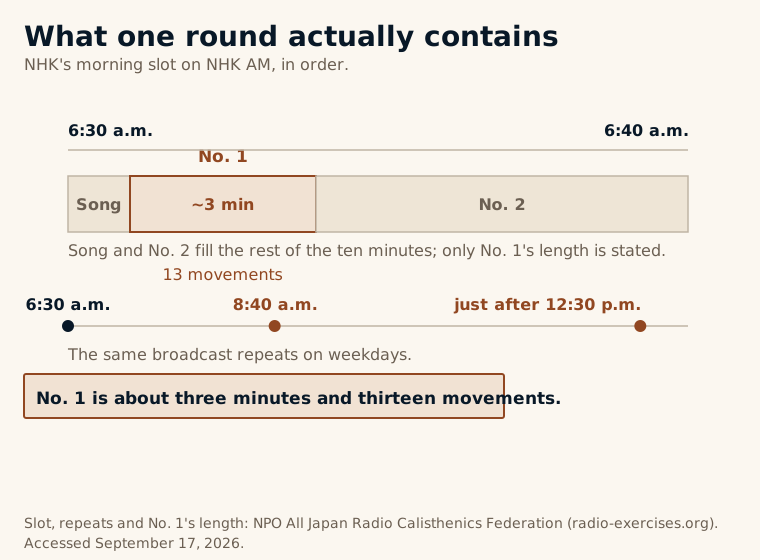
Radio Taiso is a specific broadcast with a schedule, not a generic label for a short stretch video. NHK carries it on NHK AM every day at 6:30 in the morning, running the Radio Taiso song and then Radio Taiso No. 1 and No. 2, and the federation that promotes it publishes the slot as 6:30 to 6:40, with weekday repeats at 8:40 and just after 12:30 since NHK's three radio channels became two on 30 March 2026. Radio Taiso No. 1 on its own is about three minutes and thirteen movements. Knowing which of those you are looking at is the whole first step.
Where it comes from, and who made it
Japan Post Insurance states that its own predecessor, the Postal Life Insurance Bureau of the Ministry of Communications, established the exercises in 1928 as National Health Calisthenics, and that NHK's radio broadcasts spread them, with the routine restructured in 1951 and 1952 into Radio Taiso No. 1 and No. 2. The federation dates the first broadcast precisely: Tokyo Central Broadcasting Station began airing Radio Taiso on 1 November 1928, and the No. 1 set in use today is the third generation, from 1951.
The federation's history page adds where the idea came from: health exercises broadcast by radio at the Metropolitan Life Insurance Company in the United States in 1925 were reported back to Tokyo by an official of the Postal Life Insurance Bureau, who proposed a Japanese version. In the first years, when a radio was not yet a thing every household owned, post office staff around the country learned the movements and taught them in person, because a spoken cue and a diagram do not carry a shoulder rotation.
A third program joined them later. Japan Post Insurance records that Minna no Taiso was established in September 1999, tied to the United Nations International Year of Older Persons and designed on universal-design principles so that age, sex and disability are not barriers to taking part. Three named programs, three different things to link to, and a search result that shows a group in a park at dawn could be any of them.
What one round actually contains
The federation's textbook puts the structure plainly. Radio Taiso No. 1 and No. 2 each consist of thirteen movements, arranged to move nearly all of the roughly 200 bones and 400 skeletal muscles that hold the body up. The sequence is built like a hill: the load rises through the first ten movements and eases from the eleventh, so a round ends lower than it peaks.
That is a description of a program, not a prescription for a person. In CDC's categories, three minutes of anything is a short bout whose intensity depends on how hard the body is working — you can talk but not sing at moderate intensity — and a named routine does not come pre-sorted into aerobic or muscle-strengthening work. The federation itself publishes the exercises as a warm-up and a cool-down as much as a session: three minutes before something else, or after it.
The ten-minute broadcast is the other useful number. It holds the Radio Taiso song, then No. 1 and No. 2, which is why the slot is longer than the three minutes people remember. If you are looking for the short version, you want one set, not the program.
Check the clip before you follow it
Six lines settle what you are watching.
- Uploader. Is the account linked from NHK's program page or the federation's?
- Program. No. 1, No. 2, Minna no Taiso, or something else with similar music?
- Format. Broadcast, demonstration, event footage, or edited commentary?
- Language. Can you follow the narration and any on-screen notes?
- Purpose. Are you learning the context, watching, or looking for instruction?
- Open question. What cannot be settled from the clip alone?
An example of a completed note: federation page, Radio Taiso No. 1, demonstration rather than broadcast, Japanese narration, thirteen movements in about three minutes, watching for context. That is a real answer. A recording of a neighborhood gathering is not an invitation to that gathering, and a participant's movements are not instructions addressed to you.
The music has an owner, which matters if you plan to use a clip anywhere public: Japan Post Insurance holds the copyright in the Radio Taiso No. 1 accompaniment and shares the broadcast rights in No. 2 with NHK, requires an application about a month ahead, and charges no usage fee for either.
Watching can be the whole outcome. A correct name, a reliable page and a sharper question is a reasonable place to stop — the same footing as keeping an adaptation honest when you do borrow something, and a reminder that a pleasant ritual does not need a health claim attached to make it worth three minutes.
Sources and further reading
- Radio Taiso (NHK)Accessed 2026-09-17
- NHK radio and television broadcast times (NPO All Japan Radio Calisthenics Federation)Accessed 2026-09-17
- The uses of Radio Taiso, excerpt from the Radio Taiso and Minna no Taiso textbookAccessed 2026-09-17
- Radio Taiso and Minna no Taiso (Japan Post Insurance)Accessed 2026-09-17
- The history of Radio Taiso (NPO All Japan Radio Calisthenics Federation)Accessed 2026-09-17
- What Counts as Physical Activity for AdultsAccessed 2026-09-17