
Write three lines after the pause, and keep the third one. What you did, what you noticed, and what else was different that day: the third line is what stops "I sat outside and felt better" from hardening into "sitting outside fixed my stress". The condition that would change the answer is the one thing a note cannot contain, which is a comparison group, so the note stays a preference and a preference is enough to plan next week with. Three lines, then stop.
Three lines, and the third is the one that matters
I did. The activity, the place, the company, roughly when and for how long. "Porch, after lunch, about half an hour, alone" is a complete entry.
I noticed. One concrete observation, or a plainly personal impression. "Stayed with the book for several pages" is concrete. "Felt calmer than usual" is an impression, and labeling it as one costs nothing.
What else was different. This is the line that does the work. It was a day off. The weather turned. A long-running email thread ended that morning. Someone came home in a good mood. None of those has to be ranked or ruled out; listing them keeps the pause from becoming the only candidate by default.
A fourth line is optional: what you would choose next time. Repeat it, change one thing, or do something else entirely.
If you cannot remember how long it lasted, write "a short while". A number invented after the fact looks like measurement and is not.
What a comparison group buys that a note cannot
NCCIH's guide to reading a research article describes the structure in one sentence: in a controlled clinical trial, researchers compare the effects of different treatments in groups of study participants who are as identical as possible in all other respects, with a control group receiving standard care or an inactive substance. In a double-blind version, neither the participants nor the researchers know who is in which group.
What that structure produces looks different from a note. NCCIH reports that in delayed sleep-wake phase disorder, a 2016 review of 52 people from two studies found melatonin cut the time to fall asleep by about 22 minutes compared with placebo. Twenty-two minutes, against a comparison, in a named population, from a specific number of people.
The same page shows the limits that come attached. A 2019 review of 18 studies covering 1,021 children ran 1 to 13 weeks, and the effects on behavior and daytime functioning were not clear because the studies measured them differently. Reviews that size still end in "not clear". One porch, one afternoon and one person will not do better.
There is one number you can genuinely add up about yourself, and it is arithmetic rather than inference: NHLBI notes that losing 2 hours of sleep a night leaves a debt of 14 hours after a week. Counting hours is checkable. Attributing a mood is not.
One note, before and after
Here is an invented first draft of the kind that gets retold: "Leaving my phone indoors made me calm." It moves from an action to a cause in six words, and by the third telling it is advice for other people.
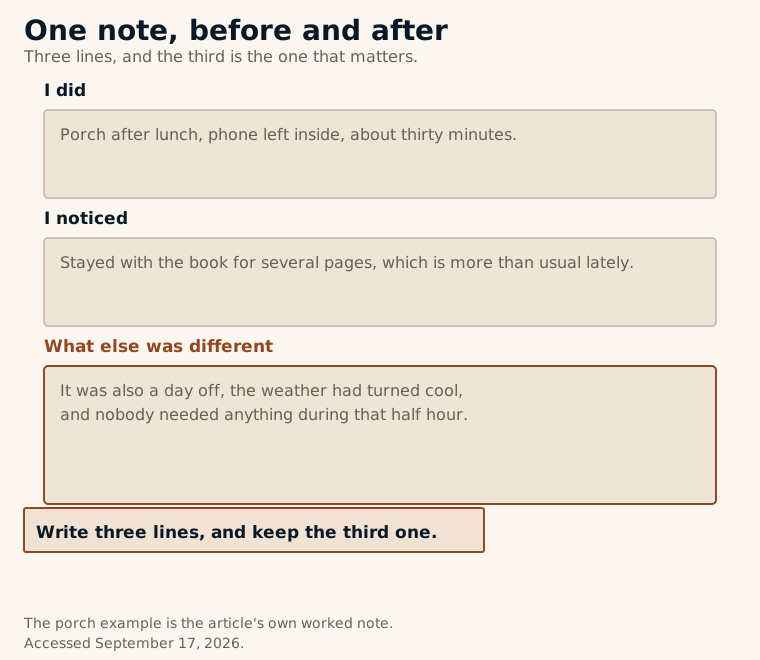
The same note as an example, with the third line kept:
Porch after lunch, phone left inside, about thirty minutes. Stayed with the book for several pages, which is more than usual lately. It was also a day off, the weather had turned cool, and nobody needed anything during that half hour. Next time: another reading pause, phone nearby if I am expecting the pickup call.
Nothing useful was lost. The note still names an activity worth repeating and a condition to adjust, and it no longer claims that a device rule treated anything or that the same arrangement will work on a Tuesday with two deadlines.
"I did not notice much" is also a finished note. A neutral half hour was a place to sit, and it does not owe anyone a result.
The same discipline is what makes a headline that names a whole country readable rather than persuasive, and it is why a ritual you enjoy needs no health claim attached to it. Keep the enjoyment, drop the mechanism, and the note stays true a year later.
Sources and further reading
- Know the Science: How To Make Sense of a Scientific Journal Article — Design of the StudyAccessed 2026-09-17
- Melatonin: What You Need To KnowAccessed 2026-09-17
- Sleep Deprivation and Deficiency: How Much Sleep Is EnoughAccessed 2026-09-17