
A country's name is not a finding. Before repeating a headline that credits a nation's habit for its health, rewrite the claim as narrowly as its source allows — and the tool for that already exists, because NCCIH's checklist for understanding health news stories asks nine questions, starting with whether the product or practice was tested on people at all. The condition that changes the work: when the story links no study, there is nothing to check, and the honest note is that the claim is unsupported rather than wrong.
Three of the nine questions settle most of them
The nine cover people, numbers, size of effect, limitations, similarity of participants, length, replication, and funding. Three do most of the work on a national story. Was it tested on people? Were enough people studied? Were the participants similar to you in ways that matter, such as age, race or sex?
A story built on a photograph, one person's account and a product link fails the first question before the other eight are reached. That is not a small gap. It is the whole distance between a report about evidence and a piece of writing arranged around a place.
A worked headline
Here is an example headline, written for this guide rather than quoted from a publication: "This country's evening cup is the secret to the world's longest lives."
Scroll sideways to see the full table →
| The phrase | What it has to name | What a real source would give |
|---|---|---|
| "This country's" | The actual people or dataset. | A study population with its size, or a national statistic with its year. |
| "evening cup" | The drink, the preparation, the amount, how often. | Grams or fluid ounces, and how the behavior was recorded. |
| "longest lives" | The outcome that was measured. | A defined figure such as life expectancy at birth, with the year. |
| "is the secret to" | The design that supports a cause. | A trial or an analysis that accounted for the alternatives. |
Four blanks, and the headline fills none of them. Leave them blank rather than filling them from memory; an invented number is worse than an unanswered question.
A national figure describes a population, not a person
Real national figures exist and are worth knowing. The National Center for Health Statistics reported that US life expectancy at birth was 78.4 years in 2023, up from 77.5 years in 2022, with 75.8 years for males and 81.1 for females. That is a precise, checkable number about a whole population.
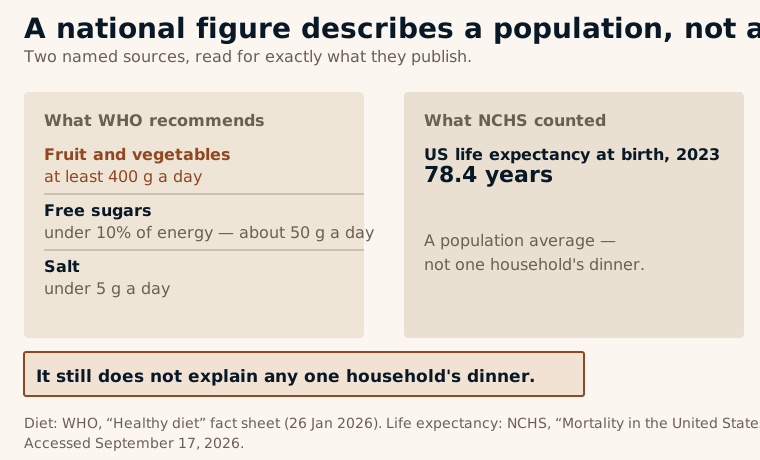
It still does not explain any one household's dinner. A population average is built from every cause of death, every income, every zip code and every year of policy in that country, and pulling one habit out of it is the step the headline skipped. It also does not establish that the featured routine is common there, which is a separate factual question with its own evidence.
What a cultural listing and a diet guideline each actually say
A UNESCO entry answers the cultural question and stops. Washoku, traditional dietary cultures of the Japanese, was inscribed in 2013 at the 8.COM session under file 00869, and describes locally sourced ingredients, New Year preparations and dishes with symbolic meaning. No participants, no outcome, no measurement — and none was intended.
The diet guidance answers the health question in numbers instead of nationalities. WHO's healthy diet fact sheet, dated 26 January 2026, sets at least 400 g of fruits and vegetables a day for everyone older than 10, free sugars under 10 % of energy intake — about 50 g — and salt under 5 g a day, and says plainly that the make-up of a healthy diet varies with cultural context, locally available foods and dietary customs. That last clause is the headline's answer: the guidance expects many menus, not one national secret.
So rewrite the sentence to the width of its evidence. A cultural source supports "this institution recorded this practice in this year." A study supports a finding about its own participants, with its stated limits. An advertisement supports only "this seller says this." Keep the interesting question — what does the practice actually consist of, and who keeps it — and drop the explanation that was never measured. When the appeal of the story was the promise rather than the practice, examine the promise on its own.
Sources and further reading
- Checklist for Understanding Health News StoriesAccessed 2026-09-17
- Mortality in the United States, 2023Accessed 2026-09-17
- Washoku, traditional dietary cultures of the Japanese, notably for the celebration of New YearAccessed 2026-09-17
- Healthy dietAccessed 2026-09-17