
Write two lines about the keepsake before you write a third: what you can see, and what you were told. Then choose one question a document could settle. That is the same split UNESCO's 1970 Convention asks of dealers, who must keep a register of the exact origin of each object they purchase under a treaty adopted on 14 November 1970 and now ratified by 149 states. The condition that changes the task: if the object could be Native American human remains, a funerary object or a sacred object, the question is not a household's to answer.
Description and identification belong in different rows
A description is what anyone standing at the table could write down: the material as far as you can tell, the shape, the marks, the measurements you take yourself with a ruler. An identification says who made it, where and when. The first costs ten minutes. The second costs a document.
Keep them apart on the page. Write "appears to be" wherever a material is your impression rather than a recorded fact, and copy a mark character by character instead of correcting it into a name you already recognize. A guess that sits in the wrong column for a year becomes a family fact by the second telling, and there is no later step that removes it.
Resemblance is the weakest evidence there is. Patterns travel, moulds get reused, and a shape shared with a museum photograph says almost nothing about one bowl on one shelf. Treat a visual match as a lead to check, never as an answer to record.
A provenance line is a chain of documents
The 1970 Convention, which entered into force on 24 April 1972, works through paper. States that join it introduce a system of export certificates and prohibit the export of cultural property that travels without one, and the register they ask of dealers lists exact origins rather than likely ones.
A household version holds the same kinds of entries: a receipt, a maker's mark, original packaging, a dated photograph, a letter that mentions the object. Where the paper stops, the identification stops. "Bought while traveling" is a recollection about a place of purchase, and the place of manufacture is a separate fact that needs its own evidence.
Some objects are not yours to identify
The Native American Graves Protection and Repatriation Act was enacted on 16 November 1990, and 25 U.S.C. 3003 requires museums and federal agencies to inventory human remains and associated funerary objects, with the repatriation steps set out at 43 CFR 10.10. Those duties fall on institutions. What the law tells a private household is simpler: this category exists, and an object inside it is handled through Tribes and institutions, not through an image search.
Use the same caution as the default for anything that looks ceremonial, funerary or restricted. A public description of a practice is not permission to copy its designs, and it is never permission to turn the object into a wellness product. When you want the name of the practice an object belongs to, start with the institution that holds the name instead of with a resemblance.
Store it, date it, and leave the gap visible
The National Archives sets the home conditions plainly: keep the temperature below 75 °F (24 °C) and the relative humidity below 65 %, and keep humidity above roughly 15 %, because drier air makes materials brittle. Damp basements, garages and hot attics are the three places it names to avoid.
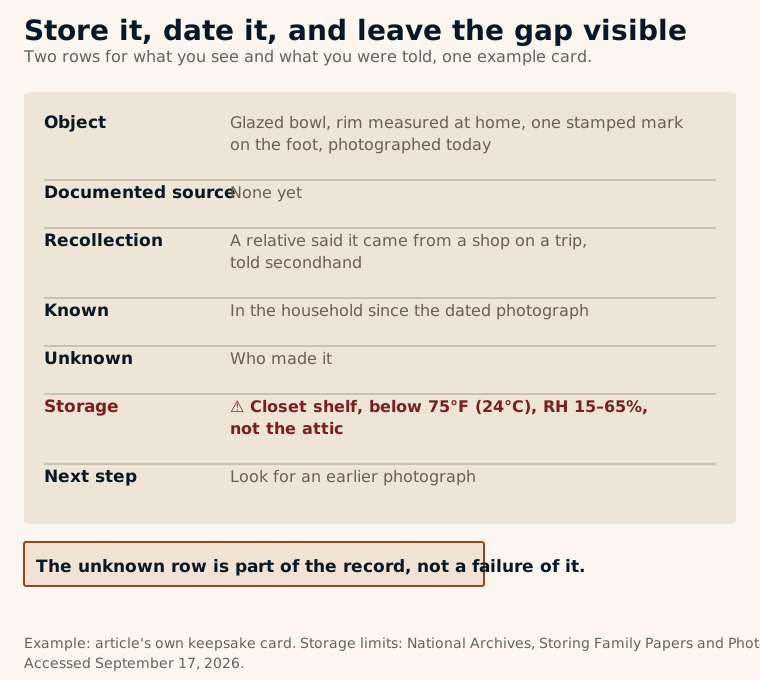
Here is an example card built on those figures. Object: a glazed bowl, rim measured at home, one stamped mark on the foot, photographed today. Documented source: none yet. Recollection: a relative said it came from a shop on a trip, told secondhand. Known: it has been in the household since the dated photograph. Unknown: who made it. Storage: a closet shelf on the ground floor, below 75 °F and under 65 % relative humidity, not the attic. Next step: look for an earlier photograph.
Every line on that card can be checked, which is what makes it worth more than a confident answer. The unknown row is part of the record, not a failure of it. When you describe the object to someone else later, keep the source and your own additions in separate sentences, and when you pass the story along, say who told you and what they were describing.
Sources and further reading
- About the 1970 ConventionAccessed 2026-09-17
- Repatriation of Human Remains and Associated Funerary ObjectsAccessed 2026-09-17
- Storing Family Papers and PhotographsAccessed 2026-09-17