
Keep the ritual if you want the occasion again and the arrangement fit. Change one named detail if a single part of it did not. Leave it in every other case, and leave it without a justification, because an optional activity needs none. The reason to run the question at all rather than drift is that some of these occasions carry something scarce: the CDC reports that about 1 in 3 US adults report feeling lonely and about 1 in 4 report not having social and emotional support. The condition that changes the answer: when someone else is part of the occasion, their answer counts as much as yours, and agreement once is not a standing promise.
Count the whole arrangement, not the visible part
The visible part is the twenty minutes at the table. The arrangement is everything around it: shopping, preparation, transport, spending, cleanup, and the messages needed to get two people in one place. The same short drink can cost one person four minutes and another an hour and a bus fare.
Write the real total before you judge the occasion, because the thing you disliked is usually in the arrangement rather than in the twenty minutes. A streak count answers none of this. Neither does the question of whether the ritual is impressive.
The three branches
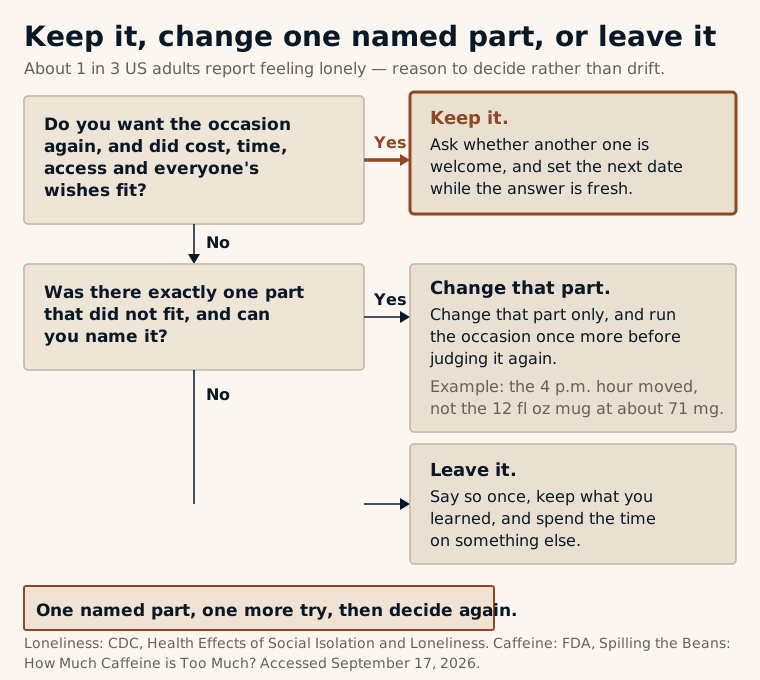
The branches sort a preference. They do not measure discipline, and none of the three outcomes says anything about the culture or the person the idea came from.
Change the detail that caused the trouble
If the problem was the trip, a new pot will not fix it. If the problem was an evening that ran long, simpler food will not fix it either. Name the obstacle in one sentence, then change that.
Where the obstacle is the drink, the change is a number rather than a purchase: the FDA lists about 71 mg of caffeine in a 12-fluid-ounce serving of black tea and about 37 mg in the same serving of green tea, with 400 mg a day cited as an amount not generally associated with negative effects in healthy adults. Where the obstacle is time, the CDC's adult guideline gives the arithmetic for a walking version: 150 minutes of moderate activity a week, which it spells out as 30 minutes a day on five days.
Here is an example of the change branch with real figures. The occasion was a weekday afternoon tea at four, a 12 fl oz mug of black tea at roughly 71 mg, twenty minutes at the table. The part that did not fit was the hour: four o'clock landed in the middle of work. The change is the hour, not the drink, and everything else stays. One detail moved, one more try, then decide again.
A borrowed idea is not on trial
An occasion you leave behind says nothing about where the idea came from. UNESCO's entry for the culture of çay, inscribed in 2022 under file 01685 on a joint nomination by Azerbaijan and Türkiye, describes hospitality in named places, not a technique that either works or fails in your kitchen. Your verdict covers your version of it, on the day you tried it, with the people who were there.
That also means the name may need to change with the arrangement. When you keep the idea but move most of the details, keep the source credited and call your version what it is; the two-sentence note is the whole job. Finish with one line, written down or just decided: "For now, this stays as it is, because ___." The phrase "for now" is doing real work, because circumstances move and a decision made this month is allowed to be revisited in the next. Then take the next idea on its own terms, starting with what its name actually refers to.
Sources and further reading
- Health Effects of Social Isolation and LonelinessAccessed 2026-09-17
- Spilling the Beans: How Much Caffeine is Too Much?Accessed 2026-09-17
- Adult Activity: An OverviewAccessed 2026-09-17
- Culture of Çay (tea), a symbol of identity, hospitality and social interactionAccessed 2026-09-17