
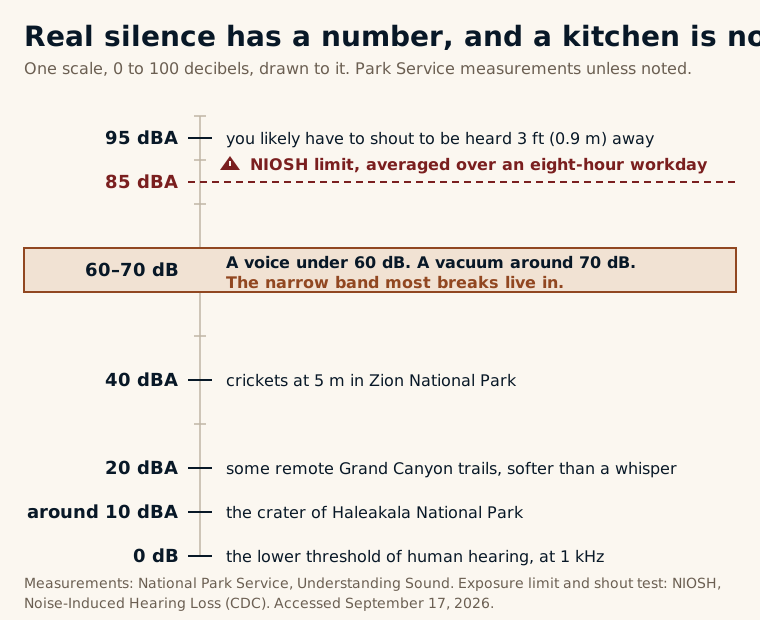
Decide what the pause is for, and the sound follows from that. The National Park Service measures a normal speaking voice at under 60 dB and a vacuum cleaner at around 70 dB, which is the narrow band most breaks actually live in, so the choice is conversation, one album, or whatever the room is already doing. The condition that settles it faster than any preference: if someone else is in the room, their answer comes first. Ask before you play anything.
Real silence has a number, and your kitchen is not near it
Park measurements are the useful correction to the idea that a pause needs quiet. NPS reports that some remote trails in Grand Canyon National Park sit at 20 dBA, softer than a whisper, and the crater of Haleakala National Park hovers around 10 dBA, against a lower threshold of human hearing of 0 dB at 1 kHz. Those are places reached by planning a trip.
A kitchen with a refrigerator, a street outside and someone in the next room is nowhere near that, and it does not need to be. NPS's own table puts crickets at 5 m in Zion National Park at 40 dBA, which is roughly the texture of a quiet room with a window open. Quiet, in a household, means fewer demands rather than fewer decibels.
Stop measuring your break against a canyon.
Three ordinary arrangements
Scroll sideways to see the full table →
| Arrangement | It fits when | Settle this first |
|---|---|---|
| No added sound | You want fewer things to pick and follow | Which household sounds are staying anyway |
| One known album | Listening is the occasion, not the background | Whether everyone in the room wants it |
| The room's own sound | You are staying where you already are | Whether a conversation or announcement needs you |
None of the three is the healthy one. No frequency, genre or recording earns a higher row, and a pause with a podcast in it is not a failed pause.
If you pick music, pick something already on your shelf or in your library. Browsing becomes the break otherwise. When the music comes from a tradition you are reading about, keep the artist's name and the recording's actual title; a label such as "Eastern calming music" tells a listener nothing about who played it or where.
The one loudness that carries a limit
Volume has a published ceiling, and it comes from work, not from rest. NIOSH sets a recommended exposure limit of 85 A-weighted decibels averaged over an eight-hour workday, and recommends halving the exposure time for each 3 dBA increase. CDC gives a field test for the neighborhood of that limit: at 95 dBA you likely have to shout to be heard by someone 3 feet (0.9 m) away.
That is an occupational limit for hours of exposure, not a rule for a twenty-minute break with headphones. Volume is easy to check. It is still the one number worth carrying, because it converts "loud" into something you can check without an app: if the person beside you cannot hear a normal voice, the volume is doing more than the occasion asks.
Ask the room, then leave a way out
An example of the whole decision in one exchange. Two people sit down at the table after lunch. One wants to talk over a letter that arrived; the other has a new album queued. The question that works is specific: "Talk now and the album after?" The conversation happens at under 60 dB, the album keeps, and nobody has argued about whether music is restful. The useful change is that the purpose became explicit, not that one sound won.
Say it before you sit down. Decide in advance how the sound ends: after one track, when the window closes, when the call comes. Silence is not the default the others have to beat, and a mixed answer is a fine answer.
Sound is one of four things a pause needs; the seat, the access and the interruptions are the rest. The same question comes up outdoors, where agreeing on company or quiet before you set off saves the negotiation at the trailhead, and where a phone with one job is what plays the music without opening everything else.
Sources and further reading
- Understanding SoundAccessed 2026-09-17
- Noise-Induced Hearing LossAccessed 2026-09-17