
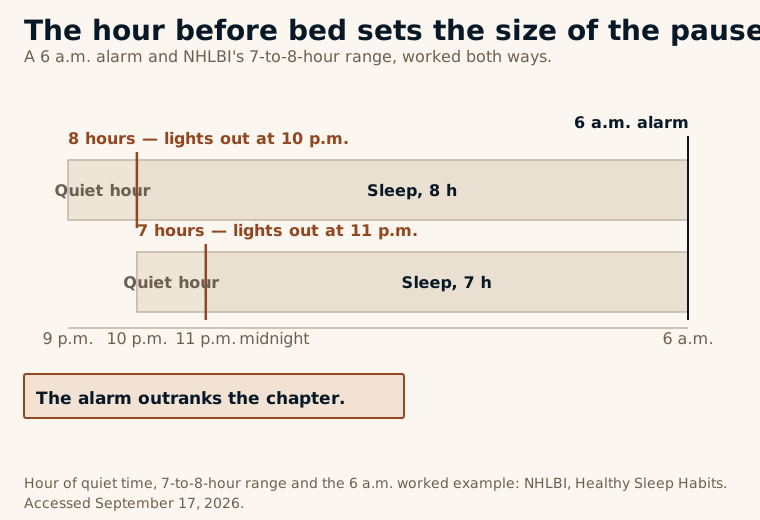
Read for the hour before bed, and count nothing else. NHLBI's healthy-sleep guidance sets aside the hour before bed for quiet time, away from intense exercise and bright artificial light, which is room for a few pages, a poem, or a chapter you will not finish tonight. One condition changes the answer: when the reading keeps pushing lights-out later, the number to protect is the 7 to 8 hours a day NHLBI gives adults 18 years or older, and the page waits. The alarm outranks the chapter.
Choose the format first, then the title
A book that feels heavy tonight settles nothing about whether you like reading. The text, the format, the place and the hour are four separate choices, and only one of them has to be made now.
There are three ordinary ways in, and any of them counts. Return to something familiar when picking a new subject is the part you do not want: a page you remember, a poem, a passage you marked months ago. Choose something short when you want a built-in ending, such as one essay or one section of a longer book. Choose audio when your eyes or your hands are busy, and stop it mid-chapter the way you would close a cover.
Large print, audio and screen text are formats, not consolation prizes. Whichever one is easier tonight is the right one tonight.
Interest decides more than genre does. If nothing comes to mind, open the last thing that held you and read two pages of it, because a choice you can make in ten seconds beats one you research for twenty minutes. Nobody has to raise the playback speed or finish the chapter for the hour to count.
The hour before bed sets the size of the pause
An example, with real clock arithmetic: a 6 a.m. alarm and NHLBI's 7 to 8 hours put lights out between 10 and 11 p.m., so the quiet hour starts at 9 or 10 p.m. That hour is the container. Inside it, the reading can be four pages or forty, and neither number is a result.
The same guidance puts a limit on borrowing against the morning. NHLBI describes sleep debt as a plain sum: lose 2 hours a night and the debt is 14 hours after a week. One late chapter does not build that. A standing habit of two more chapters does, which is the whole reason to keep the bookmark loose.
Tea and a reading hour tend to arrive together, and what is in the cup is its own question rather than part of the reading decision.
A library card is the cheapest way to change format
Before buying a different edition, ask what is already lent near you. The Institute of Museum and Library Services runs its Public Libraries Survey across approximately 9,000 public libraries with approximately 17,000 individual public library outlets, collected annually since 1988, and it records collections, public service hours and electronic resources at each one.
Scale is not the same as your branch. The survey also counts that 113 million people attended 5.2 million library programs in 2016, which tells you these are ordinary busy buildings and tells you nothing about your local hours, lending terms, eligibility or available formats. Those come from the branch itself, and one phone call settles them.
Start with the branch. Ask for a format, not for a recommendation. A book already on your shelf keeps a small reading choice from turning into an account setup.
Stop at a place you can find again
A bookmark is the entire record. No summary, no rating, no app, no streak.
Pick the stopping point before you start, and make it something you will recognize: the end of a section, the last line of the essay, the moment the hour runs out. If a responsibility ends the pause instead, let it end there and leave the bookmark where it fell. A paragraph is a legitimate place to stop. That is the whole system.
Where you read matters more than what you read. A seat you can settle into and leave easily does more for a reading pause than a better title, and whether the room is quiet or has music in it is worth deciding once instead of every evening.
When the hour ends, the only useful question is whether you wanted that time with the page. You can change format tomorrow, read nothing at all, and leave the book unfinished for years.
Sources and further reading
- Sleep Deprivation and Deficiency: Healthy Sleep HabitsAccessed 2026-09-17
- Sleep Deprivation and Deficiency: How Much Sleep Is EnoughAccessed 2026-09-17
- Public Libraries Survey (PLS)Accessed 2026-09-17