
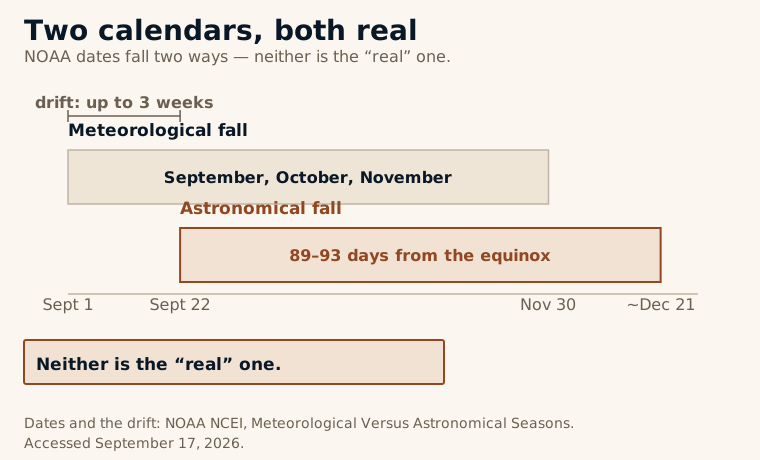
A seasonal marker works best when it is something you can check from where you stand. The calendar already gives two answers rather than one: NOAA's National Centers for Environmental Information dates meteorological fall to September, October and November, while the astronomical seasons turn at the equinox on or around 22 September and run between 89 and 93 days because Earth's orbit is an ellipse. The condition that changes it: neither calendar describes your yard, which is why the observation you write down beats the date you were given.
Two calendars, both real
Meteorologists split the year into four three-month blocks — March to May, June to August, September to November, December to February — because blocks that follow the civil calendar make seasonal statistics comparable from year to year. The astronomical seasons follow the solstices and equinoxes instead, and their unequal lengths are the reason the two systems drift apart by up to three weeks at the edges.
Neither is the "real" one. They answer different questions, and knowing which you are using keeps a personal note from arguing with a weather report.
Your zone is a number you can look up once
Where you live has a figure attached to it. USDA released the current Plant Hardiness Zone Map on 15 November 2023, and it divides the United States and its territories into 13 zones of 10 °F each, subdivided into 5 °F half zones, using average annual extreme minimum winter temperatures from 1991 to 2020 recorded at 13,412 weather stations — up from the 7,983 stations behind the 2012 version.
Look yours up once and keep it in the same note as your observations. It explains, in one number, why a neighbor three states away sees the same plant flower a month apart from you.
Phenology is the name for what you are doing
The USA National Phenology Network defines phenology as the study of the timing and cyclical patterns of events in the natural world, particularly the annual life cycles of plants and animals, and the observations people contribute feed the "Start of Spring" indicator used in the Fifth National Climate Assessment. The network itself was founded in 2007 and launched its Nature's Notebook observation program in 2009, building on a lilac and honeysuckle monitoring effort established in the late 1950s.
Your kitchen-window note is not that record. A standardized monitoring protocol and a personal line in a notebook have different purposes, and only the first supports a claim about a trend. If you want to contribute, use the program's own identification and recording instructions rather than sending your own format.
Three markers and what each can tell you
Scroll sideways to see the full table →
| Marker | What to check it against | What it cannot tell you |
|---|---|---|
| Light at your table | Sunrise and sunset times for your location, and the equinox date | Anything about the weather that week |
| A plant you can see daily | Your USDA zone and the same plant's behavior last year | Whether the region as a whole has changed |
| A food in the store | The origin label or what the grower says about harvest | That it was grown nearby, or that it is more nutritious |
Pick one marker and stay with it. The value comes from the same observation repeated, not from covering all three in a week.
A worked entry
Here is an example using the figures above. Where and when: a kitchen window, 17 September 2026 — five days before the equinox, and already the third week of meteorological fall. Noticed: the light reaches the far edge of the table in the morning, which it did not in July. Verified: the half zone printed for that ZIP code on USDA's 2023 map, copied down as the map gives it; the plant on the sill is unidentified and stays marked as unidentified. Chosen: the morning drink at that end of the table until the light moves again.
Four lines, one of them an admission of what is unknown, and nothing in it claims a season has officially arrived. When the expected change fails to appear, record what happened instead of the scene you pictured; a year that runs late is data, not a failed ritual. If food is your marker, separate "on sale here" from "grown here now" before you write anything down, and if the marker earns a pause, decide next season whether to keep it.
Sources and further reading
- Meteorological Versus Astronomical SeasonsAccessed 2026-09-17
- USDA Unveils Updated Plant Hardiness Zone MapAccessed 2026-09-17
- Why Phenology?Accessed 2026-09-17
- Our HistoryAccessed 2026-09-17