
A pleasant hour in a chair is worth having, and it counts as zero minutes of sleep. CDC's figure for adults 18 to 60 is 7 or more hours a night, and no amount of quiet, warmth or good company moves that number. The condition worth writing down rather than apologizing for: shift work, a newborn, caregiving or a second job can make the hours unavailable, and the note then describes a constraint instead of a failure. Both needs belong in the evening.
The two published numbers the evening has to fit
Two federal pages give the same answer in slightly different words, which is useful, because it shows the range is a range and not a personal verdict.
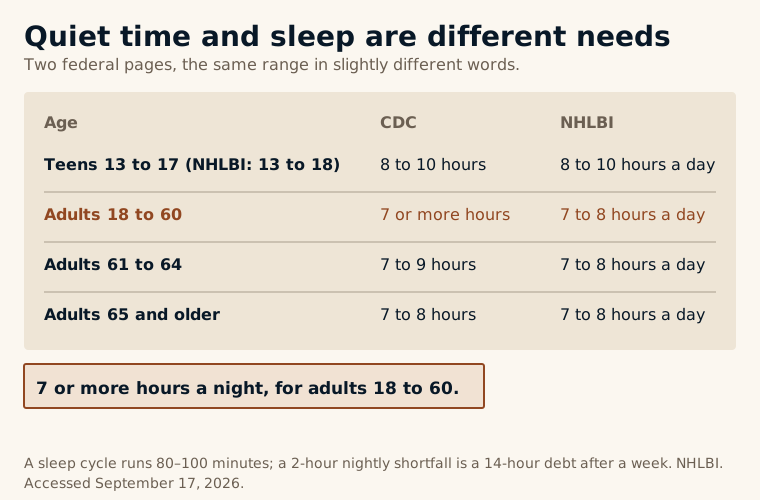
CDC publishes the age bands above on its sleep page, and NHLBI's table reflects American Academy of Sleep Medicine recommendations, giving adults 18 years or older 7 to 8 hours a day. Pick your row. Treat it as the size of the block, not a score to beat.
What sleep does that a quiet chair does not
Sleep is structured, and the structure is measurable. NHLBI describes a cycle that starts over every 80 to 100 minutes, usually four to six cycles per night.
Run the arithmetic and the guideline stops being arbitrary. Four cycles of 80 to 100 minutes is 5 hours 20 minutes to 6 hours 40 minutes, under CDC's 7 hours for adults 18 to 60. Six cycles is 8 to 10 hours. The recommended block is roughly the room those cycles need.
An hour of reading, a drink and a conversation produce none of them. That is not an argument against the hour. It is an argument for giving it its own name.
Sleep debt is the number that actually adds up
NHLBI gives the one piece of arithmetic worth doing on yourself: lose 2 hours of sleep each night and you have a sleep debt of 14 hours after a week. The same page says naps may give a short-term boost in alertness and performance but do not supply the other benefits of nighttime sleep, so lost sleep is not really made up.
Two limits sit alongside it in NHLBI's healthy-sleep guidance: keep weeknights and weekends within about an hour of each other, and hold adult naps to no more than 20 minutes. Sleeping late on days off does not clear the week's balance, and it moves the body clock that produced the deficit.
None of this diagnoses an evening. It tells you which column a change lands in.
Find the one activity that can move
An example with a real clock. The alarm is 6:30 a.m. CDC's 7 or more hours puts lights out at 11:30 p.m. at the latest. The evening currently holds dinner until 8, chores until 9, a reading pause that has no page target, and three episodes at 45 minutes each, which end at 11:45. Something has to move, and the honest question is which one, not whether the reading was good.
Two columns are enough to see it. On the left, awake rest: what you sat down for, with whom, and when it ended. On the right, sleep opportunity: the block you set aside, the activities that have to finish before it, and the wake time that is already fixed. The right column describes an opportunity, not sleep quality and not a diagnosis.
Then ask two separate questions at the end of the night. Did you want that pause? And did the evening leave the block you meant to leave? Different answers point at different changes: one of them is about the light and the screens in the room, and one of them may be about what was in the last cup.
Sources and further reading
- About SleepAccessed 2026-09-17
- Sleep Deprivation and Deficiency: How Much Sleep Is EnoughAccessed 2026-09-17
- How Sleep Works: Sleep Phases and StagesAccessed 2026-09-17
- Sleep Deprivation and Deficiency: Healthy Sleep HabitsAccessed 2026-09-17